Showing posts with label Dedications. Show all posts

25 May 2026

Of Problem Children and Adolescent Angst


Sunburst
Phyllis Gotlieb
New York: Fawcett, 1964
160 pages

Sorrel Park is no place to live, but this wasn't always so. A smallish city not far from Chicago, it was once a place of industry and well-paying jobs. During the "Open-The Door-In-Eighty-Four" policy, immigrants from Western Europe flooded in until it all went horribly wrong. First came the 1994 nuclear reactor explosion and resulting deaths. The federal government was quick to impose a press ban, the city was sealed off, martial law was imposed, the old coal plant was fired up, and the rest of the country continued on as before.

Shandy Johnson was born in Sorrel Park on June 3rd, 2011 to second generation Americans. Her father's family came from Denmark, changing their surname from Jensen along the way. Shandy's mother was named Mary O'Brian; as might be supposed, her family immigrated from Ireland. Until the explosion, Mary cleaned the offices at the nuclear facility, after which she was transferred to the coal plant. Shandy's father worked in both, even after being being struck on the back of the head with hot material. The wound would never close.

Shandy's birth, seventeen years after "the Blowup," came as a surprise. Her parents had assumed they'd been rendered sterile, but here they were in their forties with a baby girl. The joy they experienced as parents was short lived: "I was three and a half when they died, and since I can't remember much that happened before I was eighteen months old, that means I can't have really known them for more than two years..."

The novel begins on Shandy's thirteenth birthday. A strong-willed, savvy girl, she spends much of it evading capture. It didn't begin this way. Shandy had been celebrating the day with a vanilla cone and licorice stick when spotted. Shandy is a target because she is unusual. "I can't remember much that happened before I was eighteen months old," suggests something, don't you think?

New York: Berkley, 1983
Years earlier, not long after Shandy was born, dozens of Sorrel Park teens, offspring of the men and women exposed to radiation from the explosion, went on a violent rampage. It lasted no more than a few hours, but was devastating just the same. Much of the downtown lay in ruins, thanks entirely to newly awakened telepathic and telekinetic powers. It was only through dumb luck in the form of a freak accident that authorities were able to round them up. They've lived ever since in "the Dump," a prison compound equipped with a device that shields the outside world from their abilities. What sets young Shandy apart is that her mind cannot be read by those imprisoned in the Dump. She is a mutant amongst mutants, and thus of great interest to the government. 

I've never been one for stories in which radiation exposure brings the superhuman – something to so with having seen film footage of Hiroshima and Nagasaki at an early age, I suspect. It's probably the reason why the Hulk, Spider-Man, and the Fantastic Four never really appealed. 

The Hulk #1, May 1962
Yet Sunburst did appeal. It would be enough to say this all comes down to Shandy, but all the characters are brilliantly drawn. There's Jason Hemmer, who first spots the girl. He is the one mutant who cooperates with the authorities, and so is tasked with finding others. Colonel Prothelo was assigned to Sorrel Park in the aftermath of the Blowup. The son he fathered in Sorrel Park instigated that night of destruction. Cigar store owner Ma Slippec is a fleeting character, but just as fully formed. It was she who took in the orphaned Shandy, provided a modicum of stability, and introduced her to bootlegging in what is a dry city.

Of course, at the centre of it all is Shandy, a tall, awkward looking girl who is bothered by her flat chest. She longs for adolescence to really kick in, all the while worrying that she'll also develop abilities that will lead her to incarceration the Dump.

Sixty-two years ago, Fawcett positioned Sunburn as "A Science Fiction Classic of Tomorrow," and here we are in that past's tomorrow. While we don't have superhuman mutants, we do have government and corporate surveillance, suppression, manipulation and brutality. In this way, Sunburn is a classic of today.

About the author: 

Phyllis Fay Gotlieb (née Bloom)
Phyllis Fay Gotlieb (née Bloom) was born in Toronto one hundred years ago today. She attended the University of Toronto (BA, 1948; MA, 1950) where, I'm guessing, she met her husband (see: Dedication).

As far as writing goes, she was known first a poet. In 1961, John Robert Colombo's Hawkshead Press published her a pamphlet of verse. Sunburst landed in 1964, the very same year as Within the Zodiac, her first book of poems.

Toronto: McClelland & Stewart, 1964
Phyllis Gotlieb is remembered more as a writer of science fiction than as a poet. Her bibliography features twelve books in the genre, including A Judgement of Dragons for which she received the inaugural Aurora Award. 

New York: Berkley, 1980

Phyllis Gotlieb died in Toronto on 14 July 2009 at the age of eighty-three.

Dedication:


Kelly is the author's  husband, Calvin Carl Gotlieb, CM FRSC (27 March 1921 - 16 October 2016), considered the father of Canadian computing.

Of Phyllis Gotlieb's twenty other books, the one I'm most interested in reading is Phyllis Loves Kelly, (Toronto: University of Toronto Libraries, 2014), a posthumous collection of poems written to her husband over the course of their sixty year marriage.

Object and Access: A typical Fawcett Gold Medal mass market paperback original in excellent condition, it showed no sign of having been read before I got to it. I took good care.

The novel first appeared, abridged, in Amazing Stories (March - May 1964). 


Two years after the Fawcett, Coronet published the first British edition. 


When cropped, the image looks like a 'sixties LP I'd buy in a second.


Other editions followed in Australia from Eclipse (1969) and the United States from Berkley (1978). In 2002, Insomniac Press published the only Canadian edition to date as part of its Bakka Books series. 


The novel is currently available from Wildside Press of Cabin John, Maryland.

The six-decade-old Fawcett first edition is cheap in more than one way. Prices listed online range from US$6.00 to US$19.00. Condition is not a factor. At under twenty-one dollars, two signed copies of the Insomniac edition tempt, but the one you really want is a copy of the Fawcett the author inscribed to Miriam Waddington (and was subsequently owned by Maurice Forget, OC). It is being sold for $36.00 by a Gatineau bookseller.

Sunburst has been translated into French (Psycataclysme) and German (Die Geißel des Lichts).

Related post:

17 April 2025

A Gypsy in the Jazz Age; Or, Reader Meet Author


Eyes of a Gypsy
John Murray Gibbon
Toronto: Macmillan of Canada, 1926
255 pages

This past Saturday marked the sesquicentennial of John Murray Gibbon's birth. That this aging Canadian Studies and English Literature graduate first learned of him only ten years ago seems absurd. For goodness sake, the man coined the term "Canadian Mosaic."

Two years have passed since I first read Gibbon's third novel, Pagan Love, which I've described as the most remarkable, unconventional, and challenging Canadian novel of the 'twentiesEyes of a Gypsy was Gibbon's fourth novel. Could it possibly live up to expectation?

I was won over in the early pages set on the good ship Alaric. Twenty-two-year-old Maurice Arden is our hero. An artist, he comes from a long line of commercial printers who have for generations scraped by in supplying cards, pamphlets, posters, and packaging for other businesses in and around Manhattan. As his father's only son, Maurice is set to inherit the struggle, and could not be more unhappy at the prospect. 

The recent 
discovery of Tutankhamun's tomb having made Egypt all the rage, Maurice had left Manhattan – and fiancée Gladys in boozy Greenwich Village jazz clubs – for the ancient, dry Valley of the King. There he'd been inspired to create works that should prove profitable. Who knows, one might be used on the cover of a chocolate box. 

And now Maurice is on his way home.

The Alaric isn't a grand liner, but it's what the family firm can afford. All glamour and elegance is supplied by fellow passenger Jacqueline Stuart, an uncommonly beautiful woman of Scots/Romani heritage, always "two steps ahead of Vogue," who appears each evening at the Captain's TableMaurice learns the captain is a cousin, which explains her passage on so modest a vessel.

Last year's twenty-four Dusty Bookcase reads included one, two, three, four novels in which maritime accidents feature, so it came as no surprise that the Alaric strikes the hull of an overturned ship and begins to take on water.

Of the five maritime disasters, the sinking of the Alaric is the least catastrophic. No one dies. No one is hurt. No one gets wet. More anxious for his paintings than he is his soul, Maurice sets foot in the last lifeboat. At the moment it is about to be is 
lowered, he is joined by Jacqueline:
"What the hell! thundered the officer. "How wasn't she sent off with the first boats?"
   "My fault entirely," explained the lady with dazzling teeth and an accent surprisingly Scotch. "I do hate to be hurried. This 'women and children first' business can be overdone. Doesn't give us a chance to ready for this world or the next."
Their bob on the ocean is not long – they are soon rescued by the passing Belladonna – but it is long enough for Maurice to become smitten. And who can blame him. The banter they exchange reveals Jacqueline to be witty, confident, clever, and full of life. Her reasons for visiting the Old World had nothing to do with Egyptomania, rather a scandal involving a United States senator. What happened exactly is uncertain – the novel offers three differing accounts – though all rely on the glamazon's talent as a fortune teller to New York's high society.

Two ships that might otherwise have passed in the night, the Alaric and Belladonna have passengers who know one another. It's a small world after all. In Jacqueline's case, it's the senator. For Maurice, it's his friend Kenneth MacLean, an architect from the Canadian west who is traveling with his sister Peggie, herself a painter.

Eyes of a Gypsy seems a simple novel, but isn't. The introduction of Peggie (page 28) suggests formula. Blonde, pretty, wholesome, innocent, she stands in stark contrast with the dark, beautiful, sophisticated, worldly-wise Jacqueline. Skipping ahead seventy-two pages, we get this: 
The Scots-Canadian girl brought nature, the beloved mother. Jacqueline filled his dreams with more tempestuous emotions. 
And so, a love triangle.

Yes, a triangle, because Gladys is no longer in the picture. 
After the Belladonna docks, Maurice is told that his father has just died, and is handed what may be the greatest "Dear John" letter in all of Canadian literature:


This reader began settling in. I've read enough novels with love triangles to know that resolution typically occurs in the penultimate chapter.

I should have known better.

Eyes of a Gypsy does not follow a conventional path because these are not conventional characters. Moreover, Gibbon is not a conventional writer.

Time, events, relationships, and scenes move quickly in this novel.

In short weeks, Maurice manages to turn the family firm around. Peggie and 
Kenneth make a brief visit to friends in Montreal, return to New York, rent a studio, but are soon off to their parents' home in the Kootenays. Jacqueline follows, because her Romani blood is drawn to great expanses, but also to because the senator threatens. This leaves Maurice all alone, until Peggie invites him to visit.

Montreal, 1926
Once in Canada, the novel slows considerably. Plot and personages give way to loving descriptions of settings, the first being Montreal, the city in which the author spent most of his working life. The descriptions of the Kootenays, more lengthy, are accompanied by digressions on folk music, folk tales, trail riding, and First Nations culture.

It is a book the can be divided neatly in two. The first fourteen chapters have something in common with Pagan Love in that they deal with art, commerce, advertising, influence, and polished sophistication, but breaks in the last twelve which focus on the relatively simple lives and lore of those who rely on the land. That I prefer the first part says something about me. Both say much about Gibbon life – read Daniel R. Meister's Canadian Encyclopedia entry and see!

Two months ago, I won a copy of the author's first book Hearts and Faces (New York: Lane, 1916) at auction. It's set in the Bohemian Paris in which he'd studied art. I look forward to reading it and perhaps getting to know a bit more about the man, but am I wrong in wanting more about Gladys?


Favourite line: Early in the novel, a catty passenger on the Alaric says this of Jacqueline.

"If she can show us as much of the future as she does of her back, she is a wonder all right."

Dedication:

By great coincidence, my wife owns a copy of Ethel Watts Mumford's Hand-Reading Today: A New Angle of an Ancient Science (New York: Stokes, 1925), which she bought after reading Diana Souhami's The Trials of Radcliffe Hall (London: Weidenfeld & Nicolson, 1997). The latter is one of the best literary biographies I have ever read.

New Broadway Magazine (June 1908)

Object and Access: An orange hardcover, typical of its time, I purchased my copy in 2023 from an Ontario bookseller. Price: $21.00. Sadly, it lacks the dust jacket (which I've never seen).

As I write this, just one copy, also jacket-less, is listed for sale online. Price: $66.00. 

Get it while you can.

Related post:

04 March 2024

Too Soon?


Son of a Meech: The Best Brian Mulroney Jokes
Mark Breslin, ed.
Toronto: Ballantine, 1991
113 pages


News of Brian Mulroney's death last Thursday did not hit hard. I was no admirer. As a young man, I dismissed Mulroney as Ronald Reagan Lite. Simplistic, but not wrong. In 1984, the year he led his party to the second greatest electoral victory in this country's history, I was distrustful and skeptical. It came as no surprise when his government began selling off Crown assets at Fire Sale prices.

The Mulroney government spanned the better part of my twenties. He hung onto power, forcing the game into overtime, only to leave the political arena when it became clear he could not score a third victory. Mulroney all but destroyed the Progressive Conservative Party, leaving Kim Campbell and Peter Mackay to ensure its end. 

Nostalgia.

As I say, I was no admirer, though I've come to recognize the man's achievements. He somehow managed to convince Ronald Reagan and Margaret Thatcher that Apartheid was wrong, which was no small feat. He wasn't quite as successful in pushing Reagan on acid rain, but he did get a treaty through with the first President Bush. Mulroney really was our "greenest prime minister," a title included in most of the obituaries.

That he holds it still, three decades after he stepped down as PM, is a sad commentary on his successors.

Son of a Meech
Andy Donato
Toronto: Key Porter, 1990
Son of a Meech is so obvious a pun that Breslin's book is the second to use it as a title. The Meech Lake Accord was Mulroney's greatest gambit, and his greatest defeat. I was against it at the time but have since changed my position. I won't go into my reasoning as it would add five thousand words to this post. I'd much rather focus on this collection of "The Best Brian Mulroney Jokes" because it anticipates the hate, homophobia, and misogyny spread by Ezra Levant, Jeff Ballingall's Proud pages, and the Conservative Party itself.

And so, a warning to the reader, I will be quoting from this book.


Let's begin with stand-up comedian Mark Breslin's brief introduction, in which he describes how Son of a Meech was born:
After each show, members of the audience would approach me with jokes about [Mulroney] – vicious, mean, brutal – my kind of jokes. They weren't, as my literary sensei Jack Kapiica observed, the usual anti-government barbs, but personal ad hominem attacks on the man's most private self. These jokes stepped over the line of good taste, and I got interested.
Are these amongst the jokes he collected? 
Canadians no longer believe in the theory of trickle-down economics.
   Mulroney's trickled down on them long enough.

Not that the prime minister is crooked...
   But last week he swallowed a nail and it came out a corkscrew.
Perhaps not. They don't step over the line.

Variations of the trickle-down economics joke can be traced back to Reagan's first term. The corkscrew joke has iits origins in an insult General Sir Gerald Templer delivered to Lord Mountbatten.

The most interesting part of Breslin's introduction suggests that the jokes provided by his fans weren't quite so numerous as he claims:
The collection got bigger, so I turned to Martin Waxman for help. He researched volumes of comedy material of all eras for jokes about despots and cruel or incompetent leaders. Sad to say, they fit.
And so, we get these:
Did you hear the new Mulroney stamp has had to be recalled?
   People kept spitting on the wrong side.

What's the difference between the prime minister and yogurt?
   Yogurt has culture.

Why would Mulroney never be eaten by cannibals?
   Because he's too hard to swallow.

What do you call an Irish Canadian with half a brain?
   Mr. Prime Minister.
Take a tired old joke, insert a reference to Mulroney, and you're pretty much done, but not always. This one was made contemporary with a reference to yuppies:
What's the only mediocre product yuppies will buy?
   Brian Mulroney.
This one proved too difficult to update:
What's the difference between Howdy Doody and Prime Minister Mulroney?
   You can't see Mulroney's strings.
There are even a couple of blonde jokes:
How do you make Brian Mulroney laugh on Monday?
   Tell him a joke on Friday.

Looking to bolster his stodgy image, the P.M. spent the night at a rock club. And not wanting to be perceived as a square, he even snorted Sweet and Low. 
   He thought it was Diet Coke.

Tame stuff, lame stuff, these can't be the "vicious, mean, brutal jokes" Breslin says he likes.

I've given an imprecise depiction of this book's content, choosing to not share jokes involving bestiality or golden showers. There's also a fair amount of racist and homophobic writing, the most extreme being a joke that combines the two and involves the PM receiving a black coffee enema. I won't be sharing it either, but because I feel there should be at least one example of Breslin's vicious, mean, brutal jokes, I present this:
What's the difference between Rock Hudson and Brian Mulroney?
   Brian's aides have not killed him yet.
Mark Breslin's book is unlike earlier Canadian political humour books. It has little in common with Sex and the Single Prime Minister, The Naked Prime Minister, I Never Promised You a Rose GardenP.E.T., or even Andrew Donato's Son of a Meech, which seem gentle ribbing in comparison. Nowhere is this more apparent than in its treatment of the prime minister's wife, Mila Mulroney, to whom Breslin dedicates the book.


Of the dozens of jokes in which she figures, this is the most tame:
Over dessert at 24 Sussex, Mulroney whispered to Mila, "Drinking makes you absolutely gorgeous."
   "I don't drink," Mila replied.
   "Yes, but I do."
The others feature fellatio, anal sex, adultery, and descriptions of a variety of sexual positions. Plumbers feature in four of them. 'The Unity Issue,' eighth of the book's ten sections, focusses exclusively on Brian and Mila Mulroney's sex life.

Mark Breslin was appointed a Member of the Order of Canada in 2017.

Was Brian Mulroney Canada's worst prime minister as Breslin claims? Of course not. The most recent Maclean's ranking had him in eighth spot, just below Jean Chrétien, which seemed about right. But then I remembered that Mulroney accepted bribes and was a tax cheat. How about we place him in the very middle, just below eleventh place John Diefenbaker, but above Alexander Mackenzie.

Seems more than fair.

Is Breslin's Canada's worst joke book?

Beyond a doubt.

Martin Brian Mulroney
20 March 1939, Baie Comeau, Quebec
29 February 2024, Palm Beech, Florida

RIP

Object and Access: A slim mass market paperback, I found my copy two years ago in a Kemptville, Ontario thrift store. Price: $1.00.

Son of a Meech is held by seven Canadian libraries, the most surprising being the Legislative Library of British Columbia. St Francis-Xavier University, Brian Mulroney's alma mater, does not have a copy. 

Related posts:

06 February 2023

A Woman Cheated


The Cannibal Heart
Collected Millar: Dawn of Domestic Suspense
Margaret Millar
New York: Syndicate, 2017

In Margaret Millar's bibliography, The Cannibal Heart falls between It's All in the Family and Do Evil in Return. As a light and lively novel for children, the former is her most unusual; the latter, which deals with the tragic consequences of a refused abortion, is both her most controversial and most timely. The Cannibal Heart isn't so noteworthy. Of the fourteen Millars I've read to date, it ranks below the average, which is to say that it is merely very, very good.

The novel takes place almost entirely on the grounds of a large California oceanfront estate rented by the Banners: Richard, Evelyn, and their active eight-year-old daughter Jessie. The property belongs to a Mrs Wakefield, whose efforts to sell have been thwarted by a draught. Her employees, cook Carmelita and caretaker husband Carl, live with their adolescent daughter Luisa in a three-room apartment above the garage.

Someone spoken of, but not seen, Mrs Wakefield grows as a figure of mystery in the initial chapters. She at last appears as an attractive thirty-something widow worthy of sympathy. In the space of the previous two years, Mrs Wakefield has lost her husband John, as well as Billy, their only child. John was a naval engineer, a wealthy man whom Mrs Wakefield met as a schoolteacher from a small Nebraska town. Their child, Billy, was... well, let's say Billy is revealed gradually. 

But then things in Millar novels are always revealed gradually.

It's suggested that the Banners have come from the East Coast to recover from some sort of domestic disturbance. Might Evelyn's issues with jealousy be related? Even when alone, Evelyn and Richard maintain the pretence that the move has to do with expanding Jessie's horizons.

We come to know Mrs Wakefield intimately. The life she shared with her husband is something of a blur, but her experience giving birth to Billy and the days that followed are too clear for comfortable reading.

As always, Millar delves deeply into the inner lives of its characters, children included. Fifteen-year-old Luisa, a minor character (no pun intended), is a good example. Like most teenagers, she dreams of life far from her parents. In her fantasies, she's a singer with beautiful blonde hair, fawned over by handsome men with lots of money. But this can never happen in the way she imagines. Reality intrudes, reflected in the words of her father, who recognizes that she has been born "half-mulatto, half Mexican."

Syndicate Books, Millar's current publisher, lists The Cannibal Heart as a novel of suspense. It isn't. The Cannibal Heart belongs with Experiment in Springtime and Wives and Lovers, the two (and only two) novels the publisher categorizes as "OTHER NOVELS." As I wrote in a previous review, in these people do bad things; as do we all. While the reader might anticipate murder – after all, Millar was a mystery writer – nothing of the kind occurs. No character commits a criminal act, though one comes close. That that same character is the most sympathetic, most wronged, and most cheated, leads me to wonder whether I'm not right to thinking The Cannibal Heart below average Millar.

Dedication:
"For an old friend, a fine critic, and an ever-imaginative angler, Harry E. Maule."
An editor at Random House, Harry Edward Maule (1886-1971) accepted Millar's 1956 Edgar Allan Poe Award for Beast in View.

Object and Access: A bulky trade-size paperback, Dawn of Domestic Suspense is the second in the attractive (if cramped) seven-volume Collected Millar. The Cannibal Heart was the last to be read; the others have been reviewed in previous blog posts:
The Cannibal Heart is the ninth of Margaret Millar's twenty-six novels. It was first published in 1949 by Random House; Hamish Hamilton issued a British edition the following year. The Random House jacket (above right) better reflects the novel.


The Cannibal Heart was not a commercial success. It had spent over three decades out-of-print when, in 1985, International Polygonics issued the first paperback edition. A Thorndike large print edition followed fifteen years later.

As might be expected, The Cannibal Heart is uncommon in our public libraries. That serving Kitchener, the city in which Margaret Millar was born, the city in which she was raised, the city in which her father served as mayor, does not have a copy.

The Collected Millar remains in print. Used copies of The Cannibal Heart listed online begin at €6 (a first edition lacking jacket). At US$225, the most expensive is the same edition in "fine, bright dust jacket." Do not read the bookseller's description as there is a spoiler. 

The Cannibal Heart has enjoyed two translations: French (Le coeur cannibale) and German (Kannibalen-Herz).

12 October 2022

Quebec City Noir


Whispering City
Horace Brown
Pickering, ON: Global Publishing, 1947
190 pages

Whispering City may be Canada's very first film noir. This 75-year-old paperback may be the very first novelization of a Canadian film. The heroine of both is Mary Roberts, a young crime reporter with Quebec City newspaper l'Information. Mary is preparing to leave work one day when she receives a call that a woman has been hit by a truck. The accident victim, faded vidette Renée Brancourt, was once a big deal in Quebec until her lover, Robert Marchand, plunged over Montmorency Falls. The struggle to accept his death led Renée to be institutionalized. In recent years, she'd been living in a squalid flat on rue Sous-le-Cap in Quebec's Lower Town.

La rue Sous-le-Cap. Quebec City, 1947

Renée has held firm to her belief that Robert's death was no accident. She tells Mary as much from her Hôtel-Dieu hospital bed, pointing an accusing finger at Albert Frédéric.

Surely not! The man is not only the most respected lawyer in Quebec, he's a patron of the arts!

Frédéric is currently supporting talented Michel Lacoste, whose Quebec Concerto will soon be making its debut at the Palais Montcalm. Unfortunately, the composer's work on final revisions s stymied by Blanche, his shrew of a wife. Just you try working on your concerto with big band music blaring in the background. Can't be done.

Michel breaks her 78. She slaps him. He storms out, ties one on, and shows up in the wee hours at Frédéric's palatial home. It isn't long before Michel passes out. When he does, Frédéric dons the composer's overcoat and sneaks off to the Lacoste flat. His intent is to murder Blanche, just as he had Robert Marchand all those years earlier, but he arrives to find she's committed suicide. A note is pinned to her pillow, which Frédéric quickly pockets.

The following morning, Frédéric convinces a hungover and confused Michel that he killed his wife in a fit of rage. The lawyer then offers the composer a deal: Frédéric will work to save Michel from the hangman if he kills Mary Roberts. The reporter's investigation of the old Marchand murder is getting too close to the truth.


The story and screenplay are straight out of Hollywood – Americans George Zuckerman and Michael Lennox wrote the former; Americans Rian James and Leonard Lee wrote the latter – but adapt well to Quebec City.

Brown sticks close to the script, though there are departures. He improves on the dialogue and wisely does away with the talkative sleigh driver who introduces the film. Brown gives Mary Roberts a backstory as an American who had begun her career writing for a New York tabloid. In one memorable scene not featured in the film, Mary and Frédéric discuss Canadian painters. If anything, Brown depicts the lawyer as a more sinister figure – clearly a psychopath – making the book all the more dark.

Whispering City is far from a great film – its current 6.2 rating on IMDb seems fair – though I must say it gets better with each viewing. See for yourself; the film is now in the public domain. Of the muddy prints available on YouTube, this appears to be the best:


Sadly, Brown's novelization is nowhere near so accessible. This is a shame because his Whispering City improves on the film. It's easily the best Horace Brown novel I've read.

I wouldn't be surprised that it gets better with each reading.

Dedication: 

Paul L'Anglais was the producer of Whispering City and its French-language version La Forteresse.

Fun fact: In 1952, the film Whispering City was rereleased under the title Crime City. Seems a bit unfair to Quebec, especially when one considers that there's only one criminal.


Object: 
A mass market paperback bound in thin glossy covers. Whispering City is one of a very few books published by Brown's Global Publishing Company. Curiously, the spine features the name of its distributor, Streamline Books. I purchased my copy a year ago from a Burlington, Ontario bookseller. Price: US$89.95.

The novel is preceded by an enthusiastic foreword by the author followed by a "CAMERA-QUIZZ" in which readers are challenged to place twelve stills from the film in the correct order.

Don't mean to brag, but I had no trouble.

Access: The University of Calgary has a copy.

27 June 2022

E.T. Cash In


P.E.T: Pierre Elliott Trudeau and his unearthly adventures
Jude Waples
New York: Avon, 1983
93 pages

E.T. was the summer blockbuster of 1982. I saw it on my twentieth birthday.

Most embarrassing.

At twenty, Pierre Trudeau was very nearly the only prime minister I'd ever known. He assumed the office when I was in kindergarten and stepped down when I was in university, that long stretch being interrupted by 273 days of Joe Clark.

I Never Promised You a Rose Garden
Michelle Le Grand and Allison Fay
Don Mills: Greywood, 1972

P.E.T. followed Sex and the Single Prime MinisterThe Naked Prime Minister, and I Never Promised You a Rose Garden; laughs that paired photographs with imagined conversation. This being a jubilee year, I present this example:


P.E.T. is very much a departure in that it relies on illustrations and actual quotations. The concept is that Pierre Elliott Trudeau is an extra-terrestrial or perhaps one of a race of extra-terrestrials who has/have played havoc throughout the centuries. 


I read the last image as a nod to Stanley Burke and Roy Peterson. Those who were twenty or older in the summer of '82 will remember.
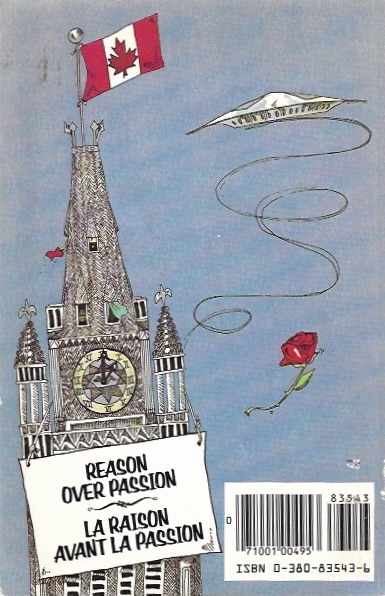
Frog Fables & Beaver Tales
Stanley Burke and Roy Peterson
Toronto: J Lewis & Samuel, 1973

The odd placement of Parliament Hill aside, most striking is the near-absence of humour; it's more mean-spirited than anything.


That's meant to be Margaret Trudeau to the right of Joe Clark.

According to the 26 May 1983 edition of the Ottawa Citizen, Jude Waples was provided the quotations, and found them "scary." "I was careful to make sure none of the quotations weren't used out of context," she told journalist Kathleen Walker.

I'm not convinced, though given current times, I found this one particularly interesting.


Well, the man did attend the London School of Economics.

Like Waples' monster, P.E.T. is an awkward thing. Not all the quotes Avon provided belong to Trudeau. Here Margaret Trudeau's words are given to a horse:


Nine years ago, I described P.E.T.: Pierre Elliott Trudeau and his unearthly adventures as the ugliest Canadian book cover of all time. The interior isn't any prettier, though I've experienced far uglier things between the covers.

Is it quibbling to point out that some of the quotations are inaccurate?

Perhaps.

There's no way P.E.T. wasn't a rush job. As exploitation product goes, I like it just as much as this strange Montreal MusicWorks single, which somehow went gold in Canada:


P.E.T. isn't quite so memorable, but is it easier on the ears.


Full disclosure: I voted Liberal in 1988. Not sure about 1997.

Object and Access: A slim, trade-sized paperback. Purchased last year for for US$12, the old World's Biggest Bookstore price sticker was a nice surprise. The five copies currently listed for sale online range in price from US$7.99 to US$115.00. Condition is not a factor. I recommend the copy going for US$7.99.

The Library of Parliament, Library and Archives Canada, Bibliothèque et Archives nationales du Québec, and five of our university libraries hold copies.


24 June 2022

'La Fête nationale' par Léon Lorrain


Léon Lorrain
1855 - 1892
RIP
Verse for the day from Léon Lorrain's Les Fleurs poétiques, simples bluettes (Montreal: Beauchemin, 1890).

LA FÊTE NATIONALE

(La Saint-Jean-Baptiste)

A L'HONORABLE M. F.-G. MARCHAND
          Vingt-quatre juin! Salut! ― Ô fête solennelle!
          Apporte dans nos cœurs l'amitié fraternelle,
          Ce sentiment si beau qu'on le dit surhumain!
          Retardez votre cours, heures patriotiques!
          Laissez-nous savourer les plaisirs pacifiques
               Dont vous semez votre chemin!

          Le soleil radieux, comme un puissant génie,
          Répand à flots vermeils le jour et l'harmonie;
          Il féconde nos champs de ses subtils rayons;
          Il dispense partout dans sa course enflammée
          La vie et l'abondance; une brise embaumée
               S'élève de nos frais sillons.

          Notre libre drapeau flotte, au gré de la brise,
          Au sommet d'une tour, au clocher d'une église
          Et domine nos champs, ― resplendissants tableaux! ―
          Sous ses replis mouvants, l'enthousiaste foule
          Se rallie et se presse, ensuite se déroule
               Ondulante comme les flots!

          Tous les cœurs sont émus par la même pensée.
          Voyez se réunir cette foule empressée.
          Elle confond ensemble, en ce jour patronal,
          Au seuil du temple saint où souvent elle prie,
          L'amour du Tout-Puissant, l'amour de la patrie,
              Dans le devoir national!

II

          Du ciel où vous vivez, de ces célestes dômes,
          Esprits de nos aïeux, ô bien-aimés fantômes,
               Venez contemplez vos enfants.
          Dans le ravissement leur âme se déploie;
          Leur chère liberté, le bonheur et la joie
               Brillent sur leurs fronts triomphants!
          Voyez qu'elle sied bien à leur tête ennoblie,
          La couronne de fleurs que vous avez cueillie, ―
               La couronne de liberté!
          Ils ne l'ont pas flétri, ce lys emblématique;
          Mais ils l'ont cultivé de leur main héroïque
               Comme on cultive un fruit d'été!
Félix-Gabriel Marchand
1832 - 1900
RIP

Related posts: